Seismic Imaging
Fraunhofer ITWM
Seismic migration and data processing
Introduction
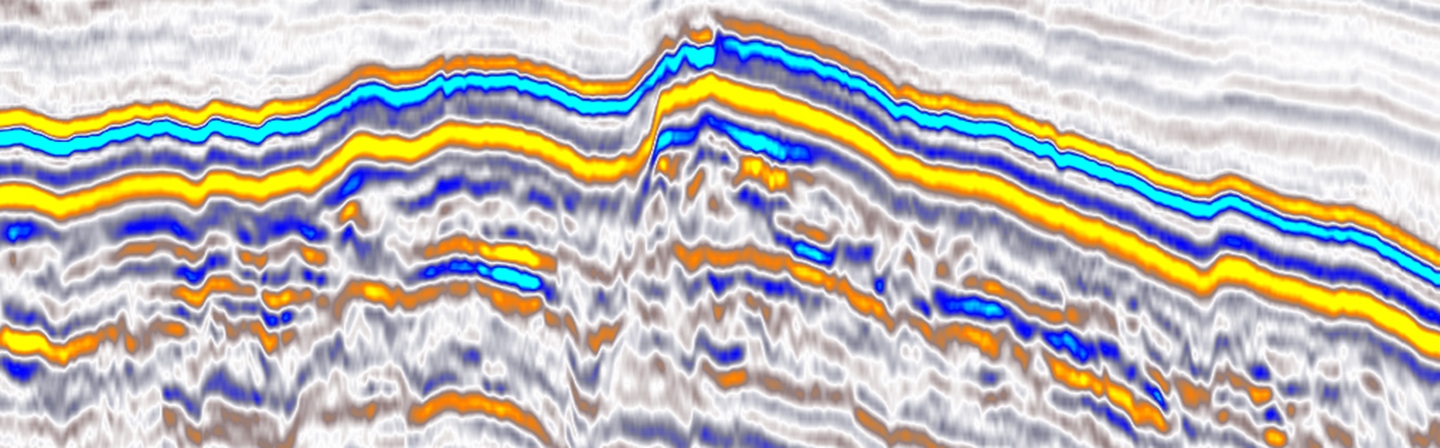
The goal of the method of reflection seismic is the reconstruction of an exact representation of the subsurface, which can be interpreted with respect to its structure and rock properties. Due to the increasing depth and complexity of reservoirs, there is a constant high demand for improved processing methods for the large amounts of data occurring during the acquisition of oil and gas. The department HPC combines the competence with respect to the efficient implementation of numerical algorithms by parallelization, vectorization, etc., on current and future hardware structures with geophysical expert knowledge. In cooperation with the oil industry, we develop new migration methods and accelerate existing methods by new implementations on modern hardware architecture. Kirchhoff migration, e.g., could be speeded-up substantially by porting the code to a cell chip cluster. Many of our new developments, as the implementation of 3D-GRT migration in the angle domain are made possible by the institute’s own concept of a virtual machine that allows to efficiently access all the seismic data held in the distributed memory area of the computer clusters.
We continuously extend our portfolio of available seismic algorithms by research work and projects whose goal is the development of production-ready codes, for example on fast beam migration methods, seismic reflection tomography, reverse time migration, full-waveform inversion, Radon transform for multiple suppression, and anisotropic filter processes. The tools developed partly exist as standalone tools, partly are imbedded into the institute’s visualization and processing/interpretation software PSPRO. The migration tools together with the gather conditioning capabilities of PSPRO offer a whole supply chain from pre-processed data to migrated images and image gathers to be used for successive interpretation.
Available methods
- 3D angle domain GRT migration
The implementation of this new method for prestack depth migration is based on the theory of the Generalized Radon Transform (GRT). The method overcomes the numerous disadvantages of conventional ray-based Kirchhoff migration schemes. Within a project sponsored by Statoil we have been able to implement this method on massively parallel computer architectures and the implementation is now representing one of the very few stringent applications of GRT theory in 3D worldwide. Special feature of the GRT migration is that the image of the subsurface is computed by representing seismic data by ray pairs that connect image points with trace locations and integrating over the take-off angles of these ray pairs. The gathers required for the further amplitude analysis are thus directly available in dependence on the reflection angle without having to know the dip of the subsurface reflectors explicitely. Furthermore, GRT solves the problems related to the multi-valuedness of wavefronts in complex media and therefore offers a better image quality for imaging beneath salt. A more practical aspect is that the input seismic data do not need to be sorted in a particular way because the method involves an implicite sorting from source-receiver pairs to subsurface angles during migration. This sorting, however, also represents the major challenge of the method because the traces are accessed a vast number of times during migration in an apriori unpredictable manner. Data pre-sorting as, e.g., for common offset Kirchhoff migration is not possible since, in principle, each trace can contribute to every subsurface point for each reflection angle. In consequence, the entire seismic prestack data set must be held in the main memory of the computer cluster.
Current results show very well the amplitude preservation of the GRT migration method in isotropic, VTI and TTI anisotropic velocity models. Beyond delivering the migration output GRT offers a whole range of quality control output that in turn can be used for further interpretation like illumination studies. Wide azimuth datasets allow to generate the reflection response in dependence on subsurface azimuth angle. The tool is close to be running in a production environment with application to TByte-scale data sets and 100s of km² output surface area. For wide azimuth data sets, migration output is obtained for each azimuth separately.
- 3D fast beam migration
Flatness criteria of migrated gathers or focusing analyses are conventionally used for evaluating the quality of migration velocity models and further to compute updates on non-perfect velocities. In complex situations as, e.g., beneath salt bodies these approaches may fail due to too poor quality of the gathers or even invisible gathers. In such situations other methods need to be applied to finding a better velocity field. A currently acknowledged approach is the trial-and-error change of parts of the salt body geometry accompagnied by fast migration that directly shows the effect of the model change on the stacked image. Geologically plausible appearance of subsurface reflectors and dips or curvatures of reflectors are valid criteria for determining whether model changes have led to an improvement. Very fast migration tools are needed for such a strategy of interactive velocity model building. Ray-based schemes like Kirchhoff migration need to be modified to provide the extreme speed needed.
We are currently developing a tool for interactive migration that consists of very fast migration schemes and a GUI that is used for salt dome editing. The fast migration follows the line of extracting velocity independent parts of the summations to a pre-processing step that needs to be done once only while during the iterative migration work only the smaller rest needs to be repeated. Together with adapted degree of data decimation, the migration of the pre-computed slantstacks lead to a speed-up of several orders of magnitude.
more information
- HPC-Flyer-GRT-EN.pdf [ PDF 0.9 MB ]
- HPC-Flyer-BeamStack-EN.pdf [ PDF 1.1 MB ]