
The Shape is Decisive – AI-Based Particle Separation in Computed Tomography Images of Rock Aggregates

Project »KIBi«: 3D Image Analysis and AI Improve Quality Control of Aggregates in Building Materials

In the »KIBi« project, we are working with our partners to develop an AI-supported process that automatically separates and characterizes aggregates in CT images, thereby simplifying and improving quality assurance and production control in the building materials industry. It is part of a special transfer program run by the Fraunhofer-Gesellschaft and the German Research Foundation (Deutsche Forschungsgemeinschaft DFG).

Aggregates have a decisive influence on the properties of concrete and many other building materials: the choice of grain size, composition, size distribution, and grain shape are crucial for the end product. In order to control these influences in a targeted manner, it is necessary to characterize the grains reliably and reproducibly.

Currently, grain shape is characterized by screening with bar sieves or manual measurement. Other methods, including automated ones, have not been able to establish themselves in production because they are still too complex, too prone to errors, and not flexible enough. 
CT as the New Standard in Characterization

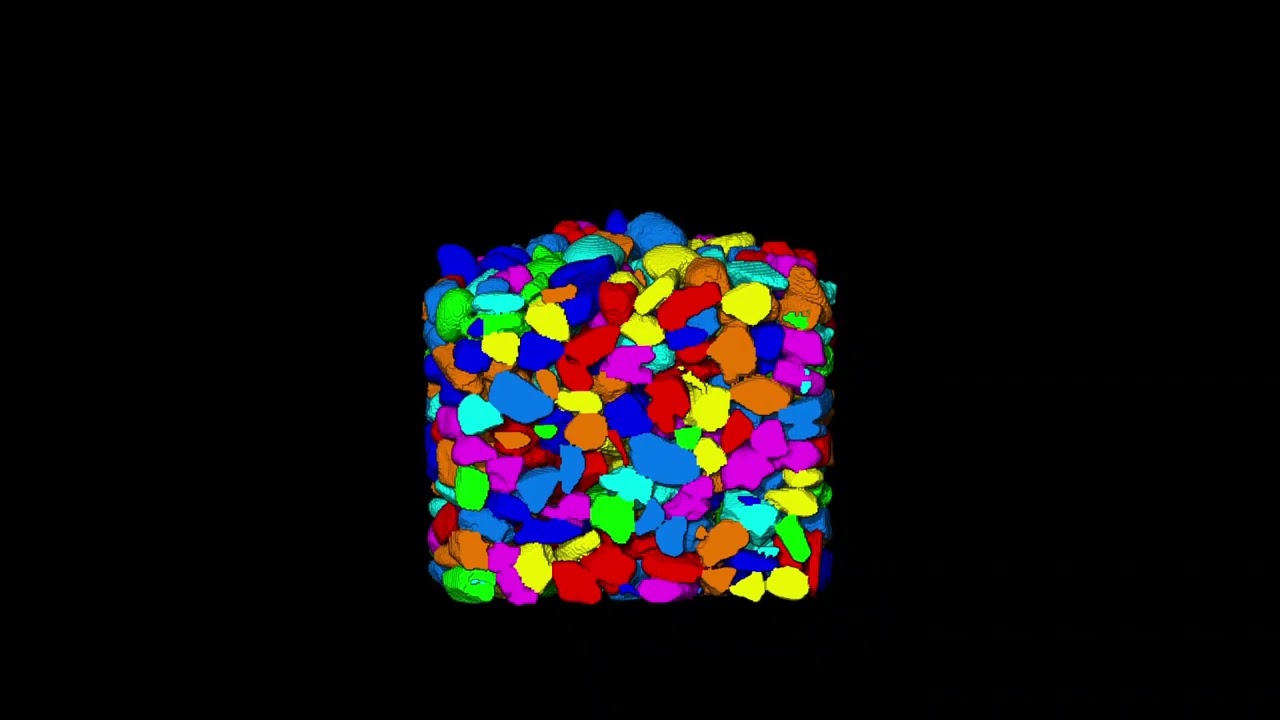
An alternative method is Computed Tomography (CT). In this project, we use computed tomography to capture the rock particles in three dimensions. In the 3D image analysis, we then identify shape characteristics that directly affect the properties of the fresh and solid materials. This opens up new avenues for objective, digital quality control.

However, this characterization via CT and analysis of the resulting 3D images is only practicable if the properties of the individual grains can be correctly determined even within a sample containing many rock grains as bulk material. To do this, it is necessary to separate the individual particles from each other using image analysis. The variety of different shapes and sizes complicates this step – classic methods such as watershed transformation often lead to oversegmentation. Adaptive methods, such as h-extrema transformation, mitigate the problem, but require a great deal of expertise to apply. In addition, there are usually too many segmentation errors, which have to be laboriously corrected manually.

Digital Detectives for Grains: Artificial Intelligence Separates Particles Without Manual Correction

In our preliminary work, we train »random forests« to automatically detect oversegmentation using so-called »triplets«. What does that mean? The triplets consist of two grains/fragments and the watershed separating them. For each such trio combination, we calculate characteristics (e.g., shape, contact area, distances).

»Random forests« are algorithms in machine learning that combine several decision trees to increase the accuracy of a statement, for example. With these learning-based models, we recognize when a grain has been incorrectly divided into too many pieces (oversegmentation) in the CT analysis and correct these errors.

We are already segmenting 27 data sets – from fine sands to recycled materials – correctly and reproducibly. However, several software tools are still in use for this, and the appropriate models are currently selected manually.

Our Goal: Software Tool Applicable in Industry

In this project, we are developing prototype software and clear procedural guidelines, bringing AI-based grain segmentation into industrial practice. 

The method developed also opens up potential beyond the building materials industry: it could support production monitoring and quality assurance in particle bulk solids in the food and feed industry (e.g., coffee beans, rice, sunflower seeds), in medical technology for monitoring filter processes, and in the raw materials industry for ores, coal, clay, or road salt.

Our Project Partners

  • Rhineland-Palatinate Technical University Kaiserslautern-Landau (RPTU), Department of Construction Material Technology
  • Basalt AG, Basalt-Actien-Gesellschaft (BAG)

The Department of »Construction Material Technology« at RPTU Kaiserslautern combines our AI expertise with many years of materials and building materials research and ensures that our algorithms are tested and evaluated using real building material data. At the same time, we work closely with Basalt AG and its BVG (Baustoff-Vertriebs-Gesellschaft), an experienced building materials producer and supplier of aggregates, asphalt, and natural stones, which underpins our approaches with practical materials, industry knowledge, and industrial requirements.

Duration and Funding

The German Research Foundation (DFG) and the Fraunhofer-Gesellschaft are funding trilateral projects such as »KIBi« to bridge the gap between basic research and application. The project is scheduled to run for three years (2025 to 2028).

Video: Use of Computed Tomography

Privacy warning

With the click on the play button an external video from www.youtube.com is loaded and started. Your data is possible transferred and stored to third party. Do not start the video if you disagree. Find more about the youtube privacy statement under the following link: https://policies.google.com/privacy

The video was produced by the Department of Construction Material Technology at the University of Kaiserslautern-Landau (RPTU).