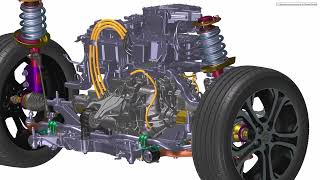
Operational Simulations of Cables and Hoses: Advanced Cable Physics

Virtual Cable and Hose Analysis: Lifetime, Vibrations, and NVH in Vehicles

At Fraunhofer ITWM, we develop methods for simulating cables, hoses, and entire piping systems quickly and realistically. We support companies in virtual product development – from assembly planning to operational simulation in vehicles.

With our expertise, we develop software products that enable users to identify potential problems early on in the digital development process. This allows us to create space for solutions before they arise in practice. In this way, we help to save time and costs while increasing quality. We are happy to adapt our methods to your specific requirements.
IPS Cable Simulation – Our Basis for Operational Simulation

At Fraunhofer ITWM, we investigate how cables and hoses react to vibrations and how these affect installation space, loads, and noise generation.

For virtual installation planning, we use our commercial software IPS Cable Simulation, which we are developing in collaboration with fleXstructures GmbH, IPS AB, and the Fraunhofer-Chalmers Centre. The focus is on precise virtual cable routing and efficient installation planning.

But our approach does not end there. We go one step further and also consider the behavior of cables and hoses in realistic vehicle operation.

We have developed solutions for these and other questions in order to identify problems and investigate possible solutions during the virtual product development stage.

Nonelinear Dynamics and NVH for Cables and Hoses

During vehicle operation, cables are excited by movement and chassis forces. We simulate cables with large vibration amplitudes, such as cables and hoses in the chassis area, in the time domain, taking into account full geometric nonlinearity.

  • Is the intended installation space sufficient even with strong inertia effects?
  • What loads act on connectors and connecting elements?

Privacy warning

With the click on the play button an external video from www.youtube.com is loaded and started. Your data is possible transferred and stored to third party. Do not start the video if you disagree. Find more about the youtube privacy statement under the following link: https://policies.google.com/privacy

Conduit system under dynamic excitation

Privacy warning

With the click on the play button an external video from www.youtube.com is loaded and started. Your data is possible transferred and stored to third party. Do not start the video if you disagree. Find more about the youtube privacy statement under the following link: https://policies.google.com/privacy

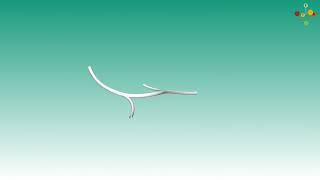
Natural mode of a hose system

Higher Frequency Vibrations and Resonance Analysis

For higher-frequency vibrations, we linearize our model and perform simulations in the frequency domain. This allows us to answer key questions:

  • What resonance frequencies occur with the given cable routing?
  • How can critical resonances be avoided?
  • How strongly are vibrations and noises transmitted along the cables?

The latter is particularly important in electric vehicles because the dominant engine noise is eliminated.

Dynamic Stiffness as the Basis for NVH Optimizations

We use two approaches to analyze noise transmission, both of which are based on »dynamic stiffness.« These show how strong vibrations are transmitted along the cables.

  1. Directly in the design: Dynamic stiffnesses support conceptual decisions, e.g., choosing the pipe variant that transmits less unwanted noise.
  2. Export for NVH simulations: The transfer functions can be integrated into detailed NVH investigations of the part or entire vehicle. This is because cables and hoses are often greatly simplified or not taken into account at all in vehicle NVH simulations due to the high complexity of the model. Our approach makes it possible to integrate cables efficiently and realistically.

In simulations of cable dynamics – both in nonlinear time domain simulations and for NVH analyses – the interaction with flexible clips is crucial. This is the only way to achieve realistic results and reflect the actual dynamics of the cables in vehicle operation.

Calculated accelerations on a vehicle component, with and without consideration of the wiring harness.
© Fraunhofer ITWM
Calculated accelerations on a vehicle component, with and without consideration of the wiring harness

Interaction of Cables With Flexible Clips and Holders

Cables and hoses in vehicles are usually attached at both ends using connectors, but often also along the length of the cable using clips, holders, or cable guides. In many simulations, these attachments are modeled in a simplified manner as rigid components. This often provides sufficiently accurate results.

However, flexible modeling is crucial in certain applications – for example, when the flexibility of the holders is needed to compensate for missing cable length. Typical questions are:

  • Can the clip hold the cable in the intended position?
  • How flexible can (or should!) a fixing be?
  • Are additional fixing points required?
  • How do the loads on the cable and fixiation change if they are flexible rather than rigid?

Such questions cannot be answered by isolated investigations of the cables or the holders, but only in the coupled simulation. 

Efficient Methodology for Flexible Fastenings

At Fraunhofer ITWM, we have developed an efficient methodology that takes into account the flexibility of clips and holders in cable simulation – and does so with virtually the same calculation time. Suitable model reduction approaches and clever formulation of the coupling are crucial here. The typically inconsistent spatial discretization poses a particular challenge.

Privacy warning

With the click on the play button an external video from www.youtube.com is loaded and started. Your data is possible transferred and stored to third party. Do not start the video if you disagree. Find more about the youtube privacy statement under the following link: https://policies.google.com/privacy

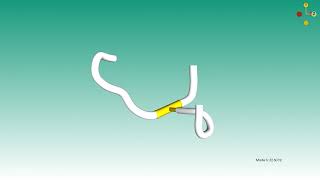
Simulated interaction between cable and flexible cable routing

Dynamic Applications and Lifetime Assessments

In dynamic applications, flexible modeling of clips and holders is usually more important than in quasi-static scenarios. It is even indispensable for NVH considerations: ideal rigid clips and holders would eliminate all vibrations – an unrealistic scenario.

Flexible fastenings also play a key role in lifetime assessments. If flexibility is ignored, simulated loads are overestimated and the lifetime of the pipe is underestimated.

Estimating Cable Lifetime – Comparative and Absolute

No matter how carefully cables and hoses have been laid out virtually, the central question remains:

  • How long will this installation actually last?
  • Or at least: Can durability be improved by routing the cables differently?

At Fraunhofer ITWM, we have developed a simulation-based method for estimating lifetime. The simulation data is evaluated using »stress recovery« – a method for reconstructing the local stress patterns along the cable – and subsequent load data analysis, and then summarized in a final damage value.

This makes it easy to compare different cable routing options – without any additional parameters. With just a few clicks, you can see whether a measure improves lifetime, has no effect, or even reduces it.

Example of one of our cable Wöhler curves
© Fraunhofer ITWM
Example of one of our cable SN curves

Expected Lifetime in Absolute Numbers

If the cable SN curve – a SN curve concept specially developed by us for cables – is available for the cable in question, absolute lifetime estimates are also possible. This is particularly valuable for new cable types or installations for which there is little empirical data available.

Cable life tests are necessary to create a cable SN curve. However, the effort involved is significantly less than with conventional iterative tests. Our method can be applied to almost any test, including historical data. The cable SN curve determined in this way can be transferred to any cable layout independently of the specific tests.

Realistic Simulation for Reliable Results

As a general rule, the lifetime estimate is only as accurate as the underlying simulation data. Choosing the right model complexity is crucial for reliable results.

In particular, the interaction between cables and clips and holders must be realistically represented. This is the only way to correctly assess lifetime and stress and make reliable statements.

Privacy warning

With the click on the play button an external video from www.youtube.com is loaded and started. Your data is possible transferred and stored to third party. Do not start the video if you disagree. Find more about the youtube privacy statement under the following link: https://policies.google.com/privacy

Cable Lifetime Prediction: Simulated Forces and Moments (Video Courtesy of fleXstructures and 3D Vehicle Data / Caresoft Global)