Bio-Based Materials: Change in Plastics Technology

Fraunhofer-Lead Project »SUBI2MA« (Sustainable Biobased and Biohybrid Materials): Fraunhofer ITWM Provides Simulations

With the lead project »SUBI2MA« (Sustainable Biobased and Biohybrid Materials), the Fraunhofer-Gesellschaft is working on a unique approach to the biotransformation of plastics technology. At the Fraunhofer ITWM, we are researching and simulating innovative bio-based materials that are fundamentally changing plastics technology. With our contribution to the lead project, we are developing digital images and simulations that make the molecular functionalities of bio-based material building blocks visible and usable for practical applications.

Together with other Fraunhofer Institutes, we are driving forward the integration of biological components in plastics. This results in materials that are not only efficient, but also sustainable – ready for new applications and markets.
Diversity Through Modular Material Solutions

The modular approach offers a wide range of material solutions:

  • new biobased high-performance polymers
  • biobased flame retardancy
  • hydrophilization/hydrophobization
  • fiber-matrix interaction
  • increasing the scope of application of established polymers

The results support the plastics and chemical industries as well as processing sectors such as construction chemicals, the automotive industry, textile chemicals and healthcare. Thanks to digital mapping, we can react flexibly to new requirements and actively support the transition to sustainable materials.

Three Focal Points in the Project

  1. Developing new biobased materials
    We provide new bio-based materials and demonstrate their potential. To this end, we develop synthesis routes, test processing technologies, characterize the materials and evaluate their properties in a practical manner.
  2. Optimizing biohybrid materials
    We improve the properties of biohybrid materials through targeted functionalization. Here too, we accompany characterization and evaluation in order to make the materials fit for industrial applications.
  3. Designing fast, sustainable development paths
    We establish fast-track developments with digital support. Simulations and a holistic ecological assessment help us to bring materials to market quickly and sustainably.
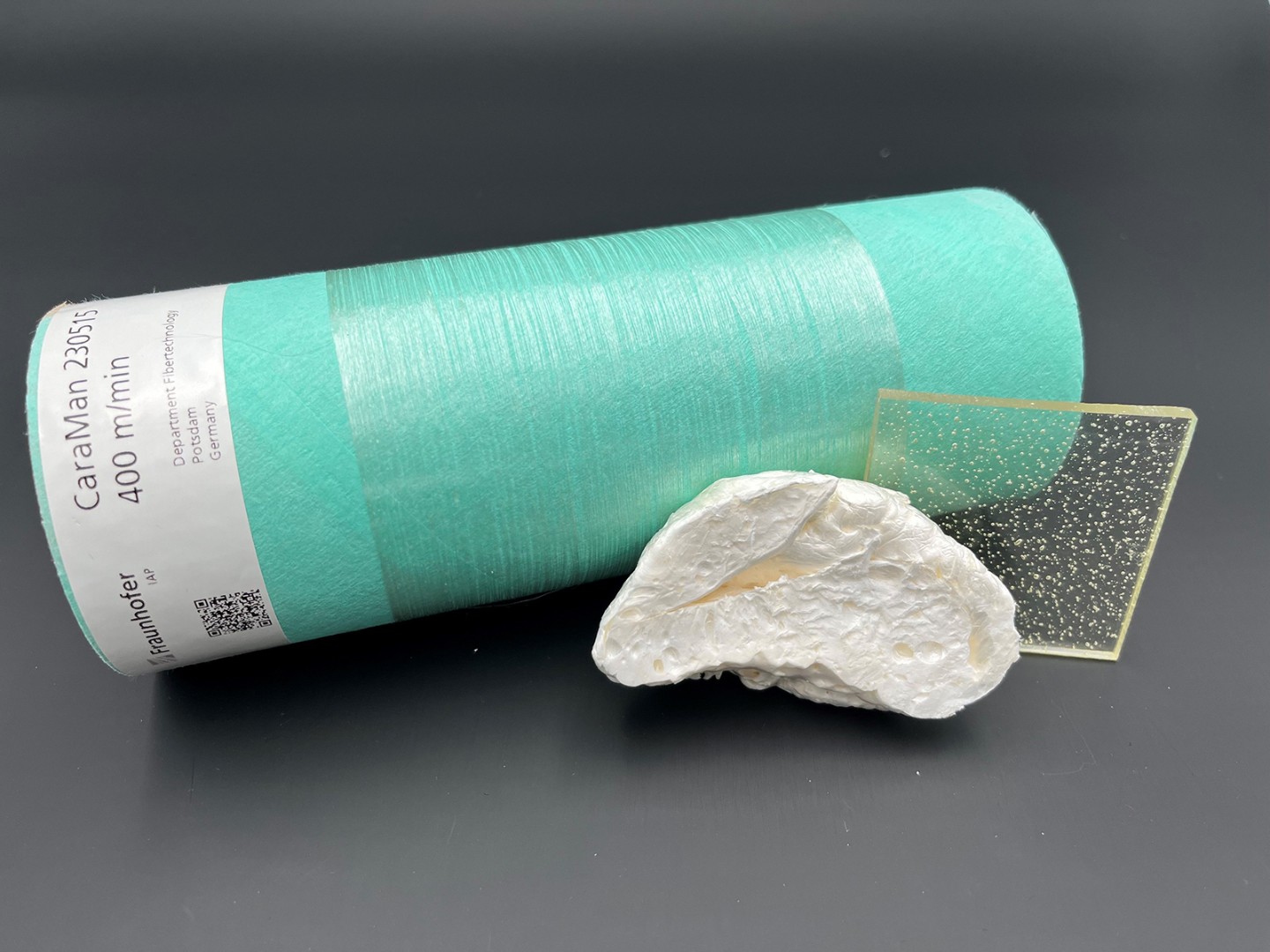
Monofilaments, foams and plastic lenses made from Caramid
© Fraunhofer IGB
Monofilaments, foams and plastic lenses made from Caramid

Our Contributions at the Fraunhofer ITWM

Our contributions are demonstrator examples in which Digital Twins are used for the development of sustainable materials:

Industry-Compatible Melt Spinning Process for Caramid Multifilaments – Simulation-Supported, Scalable and Optimized

Caramid is a bio-based high-performance plastic made from renewable raw materials. The aim of the project is to develop an industrially suitable melt spinning process for Caramid multifilaments with a scalable process control that ensures spinning stability and high spinning speeds. We are simulating both the spinning package and the spinning process as a Digital Twin in order to gain a deep understanding of the process and enable targeted optimization.

As a result, the interplay of simulation, process development and innovative nozzle technology should offer a scalable solution for the industrial production of high-quality filaments. In cooperation with the Fraunhofer IAP, a Biko wet spinneret has also been developed. A patent application has been filed for this nozzle geometry and further optimization is planned.

Multiscale Tire Simulation

One of the main problems with tires is recycling them by type: tires are usually incinerated after use and valuable materials are lost. We simulate the functional layers of a tire on a milli-scale and link them to the tire scale using our »CDTire« tool.

Our aim is to replace conventional plastic components, such as nylon filaments in the functional layers, with bio-based polymers. In this way, we are creating the basis for more sustainable tires.

CDTire/ 3D: Functional layer concept
© Fraunhofer ITWM
CDTire/ 3D: Functional layer concept
Strong Deformation
© Fraunhofer ITWM
External forces cause local compression of the functional layers in the tire.
Relaxation Simulations of the Laminate
© Fraunhofer ITWM
Relaxation causes the functional layers to bulge – triggered by the manufacturing-related pre-tension in the yarns.

Optimal Test Planning – from Synthesis to Production

Whether synthesizing novel materials, optimizing product properties or calibrating Digital Twins and improving production processes – one thing is for certain: experiments are expensive. In practice, this often leads to limitations and compromises in terms of efficiency and innovation. In the »SUBI2MA« project, experimentation is indispensable.

The software tools we have developed at the Fraunhofer ITWM for decision support in test planning help to select the right tests at the right time - targeted instead of trial-and-error. Our algorithms for optimal test planning support material and process development. With just a few, well-planned trials, iteration leads to faster synthesis routes, better product properties and more efficient processes.

Simulation of Puncture Tests with Highly Stressed Fabrics

We examine materials for airbags or protective textiles that have to withstand extreme loads. Typically, high performance plastics such as aramid or nylon are used.

In the project, our researchers are testing the resilience of bio-based fibers using these extreme examples. The tests are being carried out at the Fraunhofer IWM in Freiburg, while we are simulating the tests at the Fraunhofer ITWM and digitally map the results. By combining innovative material development and advanced simulation technology, we at the Fraunhofer ITWM are making a significant contribution to achieving the goals of the project and transforming the plastics industry in the long term.

Experimental Setup of a Cupping Test
© Fraunhofer IWM
Experimental setup for a cupping test
Failure of Individual Fibers Under Tensile Stress
© Fraunhofer ITWM
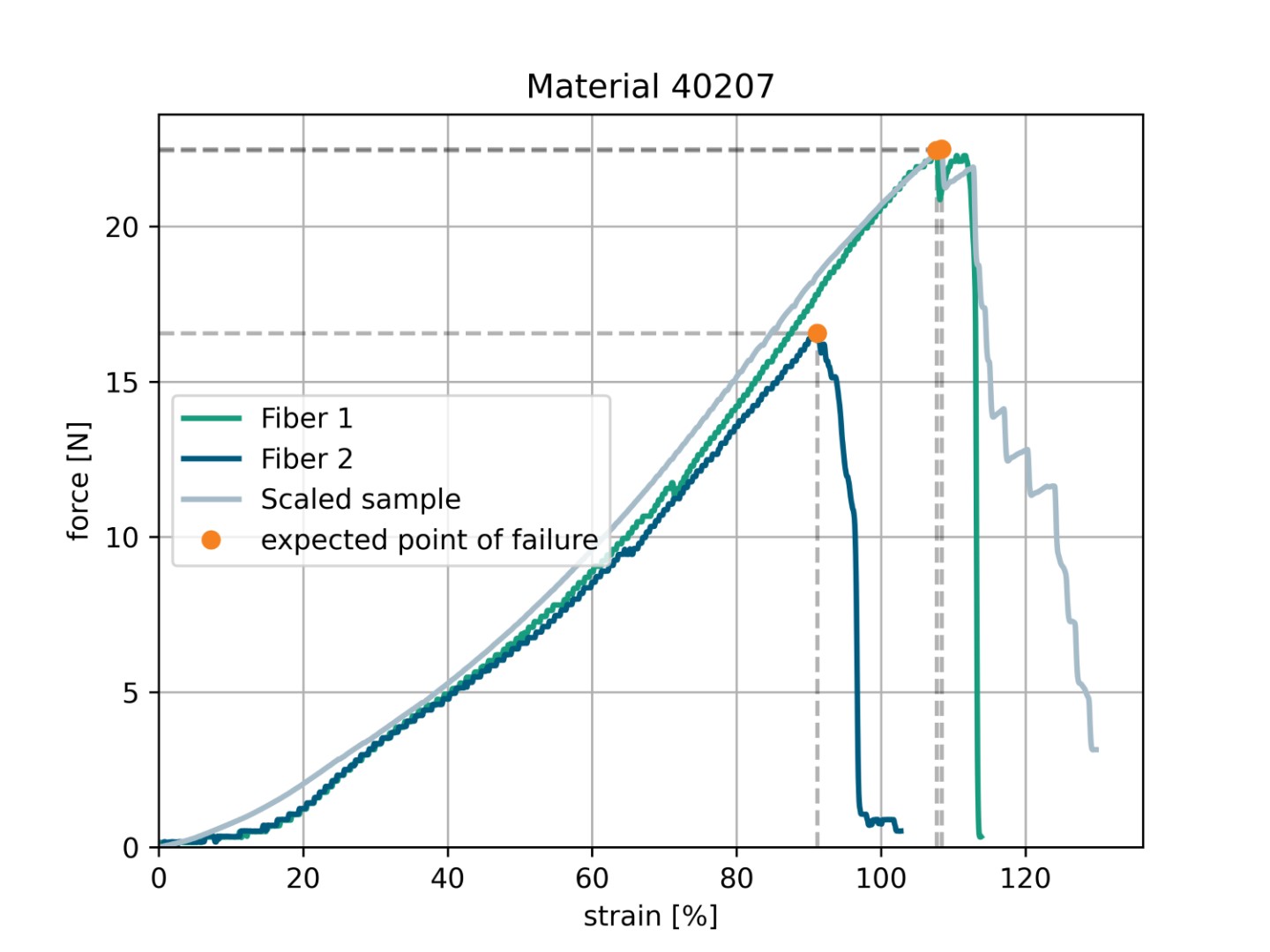
The tensile test of individual fibers and a fabric strip (grey curve) shows comparable force-elongation curves: The applied force increases similarly with increasing elongation. The point at which the samples tear (orange dots) varies, so that only one failure interval can be specified.
Force-Displacement Curves from Simulation and Experiment
© Fraunhofer ITWM
The simulation accurately replicates the puncture test: force-displacement curves from the experiment and simulation match both in terms of progression and failure point of the sample (orange dot and blue square). A force-displacement curve describes how the force applied to a material or component behaves in relation to the deformation (i.e., displacement or elongation) during a test.
Perforated Fabric
© Fraunhofer IWM
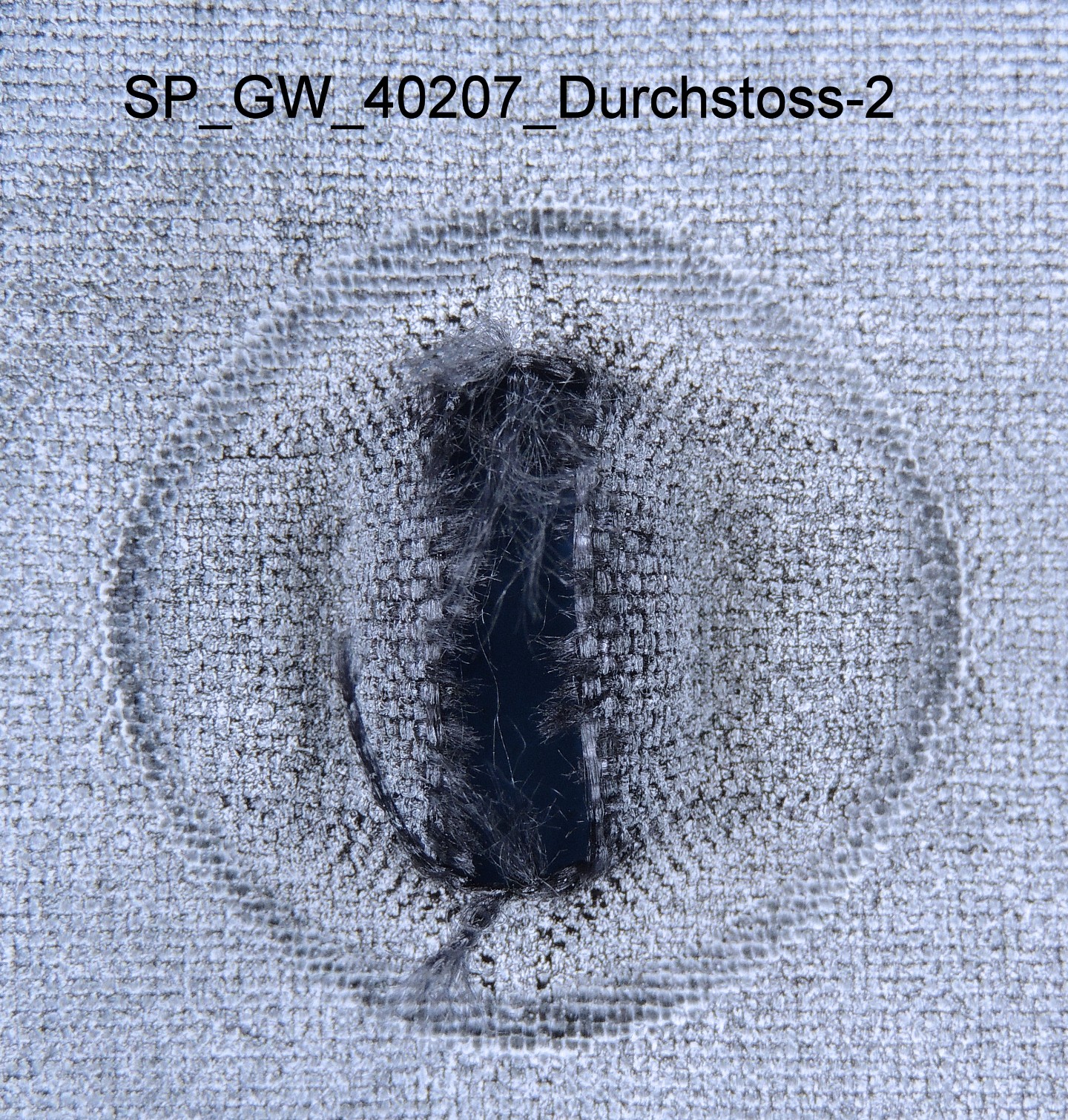
Perforated fabric after the indentation test