 Fraunhofer Institute for Industrial Mathematics ITWM
Conference, Nuremberg / March 10, 2026 - March 12, 2026
Embedded World 2026
Joint booth of the Fraunhofer-Gesellschaft (Hall 4, Booth 422)
The »Embedded World Exhibition and Conference« is the industry meeting place for leading experts from the embedded community. It offers an insight into the entire world of embedded systems: from components and modules to operating systems, hardware and software design, M2M communication and services.
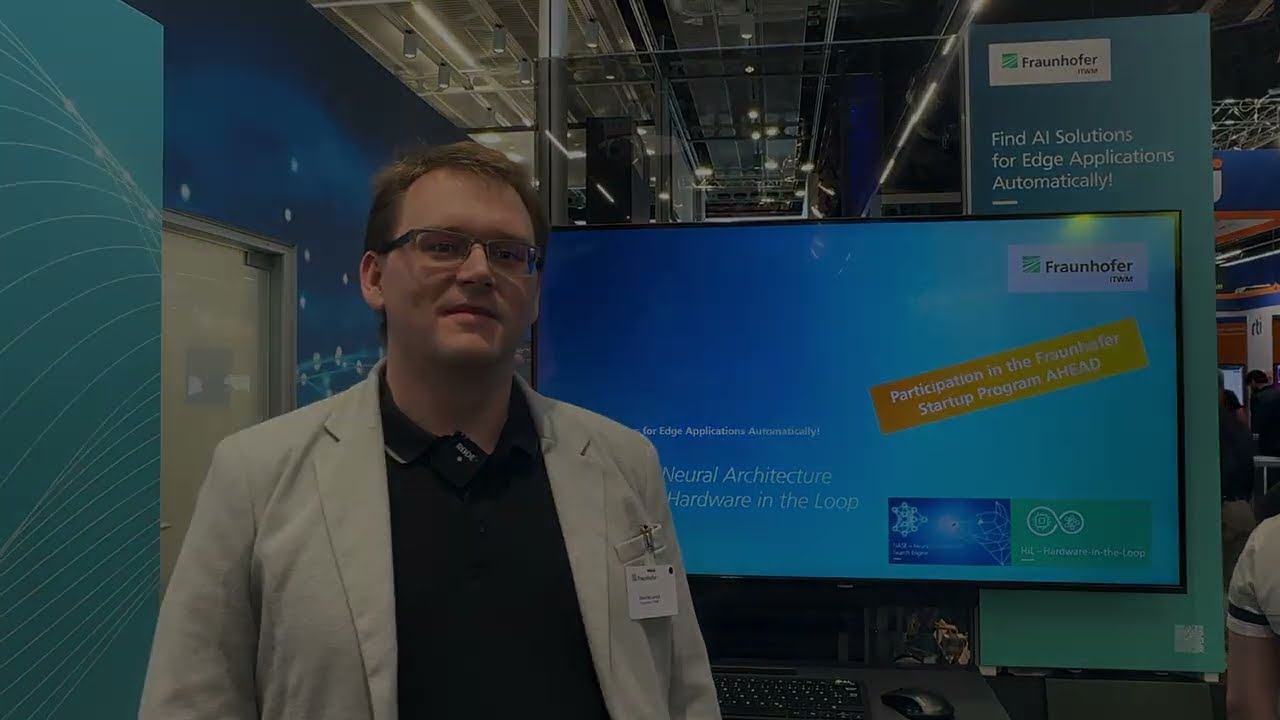
A team from the »Analytics and Computing« division and the RPTU University Kaiserslautern-Landau from the »Design of Microelectronic Systems (EMS)« department presents our AI system »Neural Architecture Search for Embedded Applications (NASE)« at the Fraunhofer-Gesellschaft's joint booth. Our project partner, the Fraunhofer Institute for Integrated Circuits IIS, is also represented at the stand.
Neural Architecture Search: The Connection Between Application and Hardware
Cloud-edge and embedded solutions increasingly adopt AI as a core component to make services more reliable and improve the user experience. But bringing AI towards the edge is difficult, as the AI models need optimization for the executing hardware platform. Common design processes do not scale, as adjusting models manually results in long development times.
Recently, agentic systems have demonstrated for many programming and development tasks that development time can be reduced significantly by the automation of design and testing cycles. Agentic AI systems can solve complex tasks reliably by interacting with external tools and testing systems. At the same time, AI agents interact with the user in natural language and explain the results in an easy to understand way. Even non-experts can utilize such systems to solve their problems, making complex technologies more accessible to everyone.
NASE (Neural Architecture Search Engine) with Hardware in the Loop, developed with our partners at the RPTU, is an agentic AI system that optimizes the execution of AI models for various edge and embedded platforms by using hardware awareness. It helps the user to specify optimization criteria and to identify the best models for the application and platform. NASE can directly design, deploy and test models on the target hardware, which allows it to verify model execution performance with real measurements. Development times can go down from month to weeks and the quality of the resulting models beats manual design.
Networking evening on »STANCE«
March 11, 2026, 5:00 p.m. – 9:00 p.m.
»STANCE« is an alliance of industry and research founded by Fraunhofer TWM and Fraunhofer IIS that promotes neuromorphic and spiking-based, particularly energy-efficient AI technologies for industrial applications.
As part of embedded world, we are hosting the »STANCE« Networking Evening at JOSEPHS in Nuremberg together with Fraunhofer IIS. The event offers compact, practical insights into neuromorphic computing and shows how intelligent, energy-efficient products can be realized. Representatives from industry, science, and start-ups come together to discuss applications, exchange experiences, and forge new partnerships.
Register now and actively participate in the exchange!