 Fraunhofer Institute for Industrial Mathematics ITWM
Lightweight construction thrives on the intelligent use of materials: the better a material is suited to its application, the more energy- and resource-efficient the product becomes. Fiber-reinforced thermoplastics (TPC) are realizing their great potential, especially in key industries such as aerospace, automotive, and energy. Together with researchers from the IVW, we are working on the »Predict-TPC« research project to improve the predictability of the properties of fiber-reinforced thermoplastics. Based on this, companies can design components efficiently and exploit lightweight construction potential.

Projekt »Predict-TPC – Entwicklung eines anwendungs-orientierten Materialmodells für faserverstärkte Thermoplasten auf Basis digitaler Mikrostrukturanalyse«: Technisches Bauteil einer Waschmaschine vor einer Waschtrommel mit Wasserdarstellung
In the project »Predict-TPC«, we are conducting research into fiber-reinforced thermoplastics in collaboration with the Leibniz Institute for Composite Materials (IVW). Our aim is to improve the prediction of material properties.
© iStockphoto / Fraunhofer ITWM
Digital Material Models for Fiber-Reinforced Thermoplastics
Project »Predict-TPC – Development of an Application-Oriented Material Model for Fiber-Reinforced Thermoplastics Based on Digital Microstructure Analysis«
An aircraft component, a battery module, or a wind turbine blade: in every case, the choice of material determines efficiency, durability, and safety. But developing new materials takes time – especially when numerous tests are needed to understand their properties. Sustainability and climate protection pose major challenges for industry and society. Lightweight construction is a key factor here: using less material means consuming fewer resources while achieving the same or even better performance. Thermoplastic composites (TPC) offer enormous potential in this area. However, their complex material properties have so far made precise design and safe application difficult – especially under long-term stress.
TPCs consist of highly rigid reinforcing fibers and a thermoplastic matrix. This combination results in materials that are particularly lightweight and resilient at the same time. In addition, they offer clear sustainability advantages: they can be melted down, enable short production cycles, and can be recycled comparatively well.
The Challenge: Complex Long-Term Behavior
The mechanical behavior of TPC is highly complex. It is determined by factors including:
- Fiber orientation
- Fiber length distribution
- Fiber-matrix adhesion
- Micromechanical interactions
For safety-related applications – such as in vehicle or aircraft construction – it is essential to be able to predict these effects accurately. Until now, researchers have had to determine the complex material behavior through numerous time-consuming and costly tests – especially when it comes to long-term aging processes.
This is where »Predict-TPC« comes in: Our goal is to develop an application-oriented material model that can be calibrated more quickly and flexibly – supported by modern simulation techniques instead of exclusively by experiments. In this way, we are laying the foundation for more efficient development processes and reliable, sustainable lightweight construction applications.
Our Approach: From Experiment to Digital Material Model
At the heart of »Predict-TPC« is the intelligent interplay of experimentation, digital microstructure analysis, and modern multiscale simulation. The first step is targeted, efficient materials testing. Innovative testing methods are used to record the key mechanical properties of thermoplastic composites – in particular their time-dependent behavior, such as creep and relaxation. The aim is to obtain the most meaningful data possible with the least amount of testing.
These experimental results are then linked to a digital microstructure analysis. Using the FiberMath and FeelMath software tools developed at Fraunhofer ITWM are used to create a digital twin of the material structure. This allows fiber orientation and fiber length distribution to be realistically mapped and mechanically examined in a virtual, flexible, and significantly more efficient way than purely experimental methods.
In a next step, these microscopic findings are transferred to a macroscopic material model. Multiscale approaches integrate the influence of the microstructure directly into the component simulation. This results in a material model that precisely describes the real behavior of the material – even under long-term stress. The result is a reliable, fast, and practical prediction of material behavior. Development times are shortened, testing costs are reduced, and components can be designed to be safer and more material-efficient.
Our goal is to systematically close the gap between microstructure and component behavior. In particular, time-dependent behavior – creep and relaxation – can be described and modeled more precisely.
The approach developed is not limited to a single material system. It can be transferred to other fiber-reinforced or generally anisotropic materials and forms the basis for future research projects.
The Project Is Divided Into Four Work Packages:
- Efficient Material Characterization:
This includes test specimen preparation, mechanical characterization, and microstructure imaging. - Macro Modeling:
This package includes the definition of constitutive equations and the implementation and validation of macromechanical material models. - Micro Modeling:
This includes geometric microstructure modeling, virtual materials laboratory, and the TPC material map. - Validation of the Methodology:
The focus here is on the production of validation samples, injection molding simulation, mechanical characterization of the validation samples, and validation of the multiscale simulation.

The simulation shows the microstructure of a fiber-reinforced thermoplastic (TPC).
Our Partners in the Project:
Leibniz Institute for Composite Materials (Dr. Sebastian Schmeer, Deputy Head of the Department »Component Development«)
Project Duration and Funding:
The Rhineland-Palatinate Ministry of Science and Health is funding »Predict-TPC« with €1.1 million. The project runs for around one and a half years – from April 2025 to December 2026.
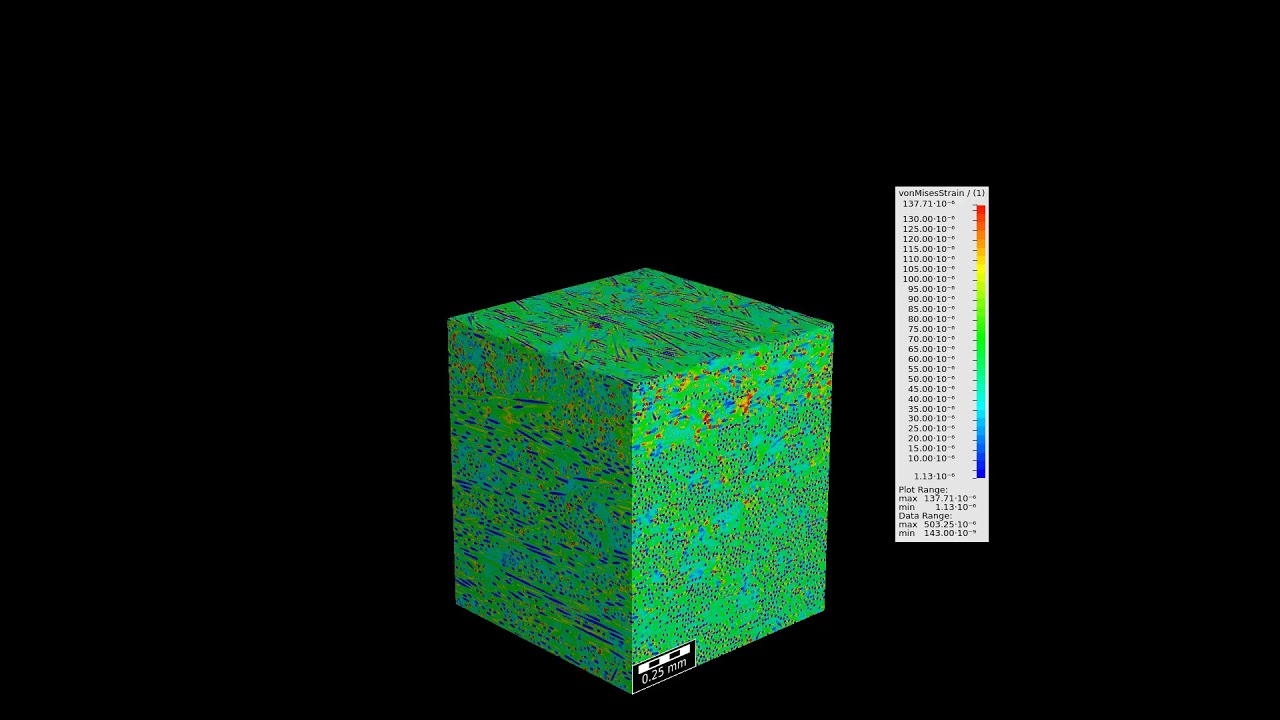
Distribution of von Mises Stress in Matrix and Fibers
FeelMath enables the calculation of local stress distribution under tensile, compressive, and shear loads on microstructures of fiber-reinforced thermoplastics (TPC). The video shows the von Mises stress in the matrix and fibers. The local distribution of von Mises stress in the matrix and fibers influences material performance and component behavior. Digital microstructure analyses in the project »Predict-TPC« enable more accurate predictions of material behavior under load.
Privacy warning
With the click on the play button an external video from www.youtube.com is loaded and started. Your data is possible transferred and stored to third party. Do not start the video if you disagree. Find more about the youtube privacy statement under the following link: https://policies.google.com/privacy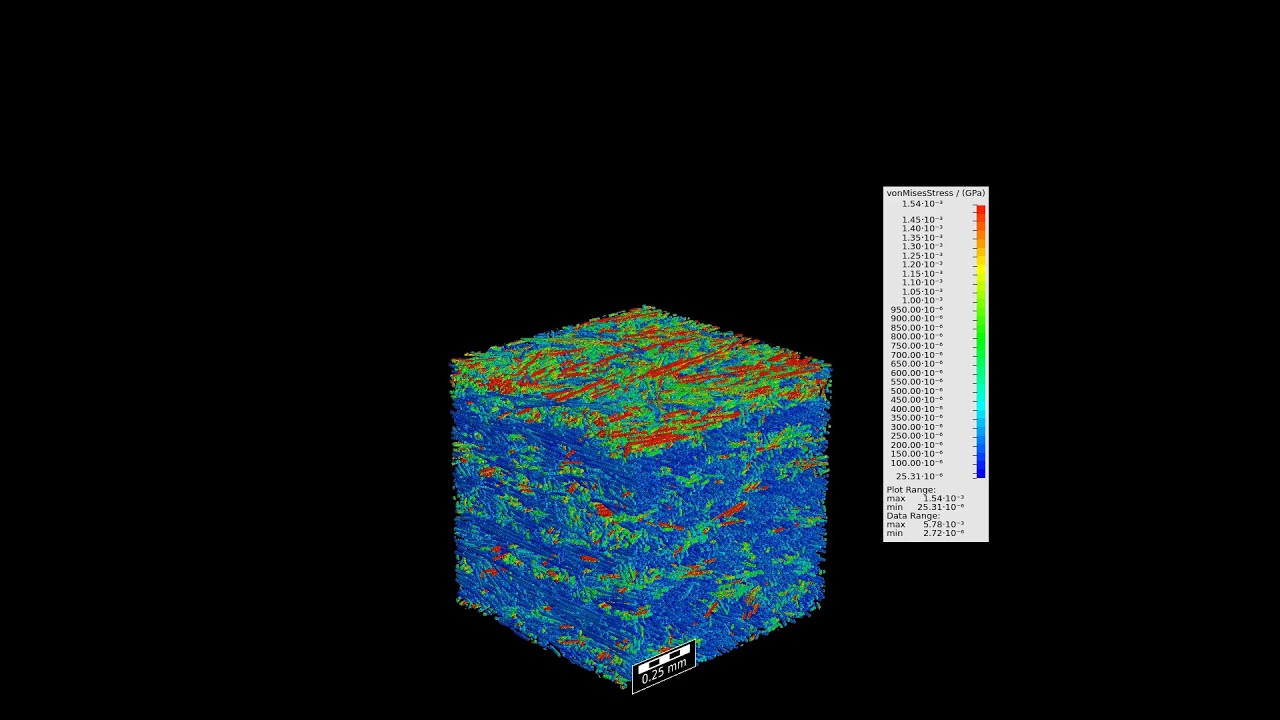
Privacy warning
With the click on the play button an external video from www.youtube.com is loaded and started. Your data is possible transferred and stored to third party. Do not start the video if you disagree. Find more about the youtube privacy statement under the following link: https://policies.google.com/privacyDistribution of von Mises Stress in the Fibers
FeelMath enables the calculation of local stress distribution under tensile, compressive, and shear loads on microstructures of fiber-reinforced thermoplastics (TPC). The video shows the von Mises stress in the fibers. An application-oriented material model in the »Predict-TPC« project enables a more precise simulation of the stress distribution.