 Fraunhofer Institute for Industrial Mathematics ITWM
In the project »DigiLaugBeh« funded by the Federal Ministry for Economic Affairs and Climate Protection, our researchers developed digital twins that can be used to optimize the selection of materials for lye containers in washing machines. By simulating components made of fiber-reinforced plastics, the project participants are finding out what a component needs to look like in order to be durable and at the same time make the appliances more energy-efficient and resource-friendly. With the completion of the project, a validated simulation approach is now available that makes the development of lightweight and durable components more efficient – with significantly less time-consuming prototype testing.

Waschmaschinen Projekt »DigiLaugBeh«: Das aktuellen Energieeffizienzlabel teilt alle Waschmaschinen in Effizienzklassen von A bis G ein. Das bedeutet auch höhere Anforderungen an die Geräte.
The current energy efficiency label divides all washing machines into efficiency classes from A to G. This also means higher requirements for the appliances. In the project »DigiLaugBeh«, the team is designing the lightweight component as a digital twin in order to optimize material and components.
© freepik
Lightweight Construction and Long Fibers Save Energy With the Help of Simulations
BMWK-Project »DigiLaugBeh«: Digital Twin Optimizes Lye Tanks of Washing Machines
Fiber-reinforced plastics and lightweight construction have become indispensable in the production of vehicles, but also in the choice of materials for household appliances. In washing machines, injection-molded components made of short-fiber-reinforced thermoplastics (SFT) have been used most often to date. They have fiber lengths of between 200 and 350 micrometers. New environmental labels have been in effect throughout the EU since March 2021. These divide all washing machines into efficiency classes from A to G. Labels with an A and a plus sign no longer exist. The new A label has very high requirements. Due to rising energy prices, customers are paying more attention to the certificates when making purchases.
Nothing Easier Than Washing – It’s All About the Fibers
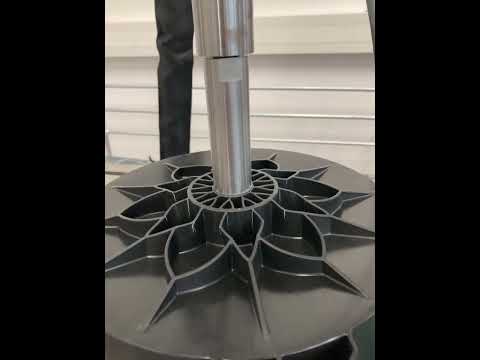
In order to meet these increased requirements, higher centrifugal speeds and, consequently, higher mechanical loads are necessary. The short fiber-reinforced plastics used to date are not up to the task. The project shows that long-fiber-reinforced plastics are a good alternative. »DigiLaugBeh« focuses on a demonstrator on which we repeatedly validate and test the methods for digital design optimization. It simulates the lye tank of a washing machine, which enables drying and washing in one device.

Als Demonstrator für das Projekt dient der Laugenbehälter einer Waschmaschine.
The process places high demands on the material in the tub – not only in terms of mechanical properties and service life, but also in terms of energy balanceNot every plastic can cope with lye in the long term, and at the same time faster spinning and lightweight construction with long fibers are seen as the solution when it comes to saving energy. This also requires robust material. Polypropylene is durable enough to solve with problem. The increasing fiber length (two to three millimeters in the component) extends the service life of the material.
Simulation Chain Thought Through to the End
But the interdisciplinary team has set its sights on even more: The development of a closed simulation chain that optimizes the component, taking into account its manufacture using injection molding or foam injection molding processes.
For this, the team combines various simulation methods in many steps. In addition, the environmental balance is taken into account – from the CO2 footprint and energy consumption to recycling.
What makes it special is that the key material properties can be obtained from just a few measurements on standardized tensile bars – for example, fiber length distribution, fiber orientation, and dynamic stiffness degradation. This information is then transferred to a multiscale simulation model.

Color-coded fiber orientation for entire component.

Simulation with mapped fiber orientation (left) and under the assumption of isotropic fiber orientation (right).
Simulation Instead of Prototypes
For the fatigue analysis, the local microstructure – i.e., fiber orientation and length – was extracted from the injection molding simulation (Moldflow) and transferred to a finite elements mesh. A mapping tool developed at Fraunhofer ITWM was used for this purpose.
The calculated results showed good agreement with experimental data. Assuming isotropic fiber orientation significantly underestimates the service life, as the fibers are primarily oriented in the direction of the load, especially in the ribs of the lye tank. The precise prediction of service life over millions of load cycles – particularly with a focus on long-term fatigue – places enormous demands on the mathematical model. The realistic representation of the microstructure using multiscale methods was crucial for the accuracy of the prediction.

Generation of a microstructure database.
Benefits for Industry
The project has succeeded in largely digitizing the fatigue analysis of long fiber-reinforced plastic components – from material characterization to component evaluation. The aim of the advanced simulation methods is to create more accurate predictions with as little measurement effort as possible.
The digital simulation process reduces the need for physical prototype testing, saving companies time and money. Material and geometry variants can be tested quickly and flexibly in virtual space. At the same time, the approach lays the foundation for safe lightweight construction: components can withstand higher mechanical loads and thus also meet the stricter requirements of the new EU energy label.
Privacy warning
With the click on the play button an external video from www.youtube.com is loaded and started. Your data is possible transferred and stored to third party. Do not start the video if you disagree. Find more about the youtube privacy statement under the following link: https://policies.google.com/privacyFatigue Test on the Lye Tank of a Washing Machine (Shortly Before Failure After 15,000 Load Cycles)
Outlook and Future Developments
The basis for the approach is a long-standing cooperation between BOSCH and Fraunhofer ITWM, in which the feasibility of such an approach has already been successfully demonstrated for SFT in the industrial research environment. At the end of the project »DigiLaugBeh«, a demonstrator adapted to the increased requirements will be designed, manufactured and tested. The digital twin will be repeatedly validated and adapted in real experiments.

Project meeting on 06 July 2023 at the University of Stuttgart
Our Partners
- Robert Bosch GmbH (Project Management)
- Math2Market GmbH
- University of Stuttgart, Institute for Acoustics and Building Physics (IABP)
- University of Stuttgart, Institute for Institute for Sanitary Engineering, Water Quality and Solid Waste Management (ISWA)
- RWTH Aachen, Chair of Plastics Processing
- Plastics Engineering Group GmbH (PEG), Spin-off of the Darmstadt University of Applied Sciences
The two associated partners BSH Hausgeräte GmbH and Celanese Services Germany GmbH provide appliances and material.
Project Funding and Duration
The project »DigiLaugBeh« was funded by the German Federal Ministry of Economic Affairs and Climate Action as part of the Lightweight Construction Technology Transfer Program (TTPLB). It ran from January 2022 to June 2025 and aimed to digitize the fatigue verification process for long fiber-reinforced plastic components.